<?xml version="1.0" encoding="utf-8"?><feed xmlns="http://www.w3.org/2005/Atom" ><generator uri="https://jekyllrb.com/" version="3.10.0">Jekyll</generator><link href="https://justathoughtblog.org/feed.xml" rel="self" type="application/atom+xml" /><link href="https://justathoughtblog.org/" rel="alternate" type="text/html" /><updated>2026-08-01T08:45:01-07:00</updated><id>https://justathoughtblog.org/feed.xml</id><title type="html">Just A Thought Blog</title><subtitle>Reflecting on faith, life, and the thoughts that shape us.</subtitle><author><name>Jeff Thomas III</name></author><entry><title type="html">The War Within</title><link href="https://justathoughtblog.org/faith/reflections/2026/08/01/the-war-within.html" rel="alternate" type="text/html" title="The War Within" /><published>2026-08-01T00:00:00-07:00</published><updated>2026-08-01T00:00:00-07:00</updated><id>https://justathoughtblog.org/faith/reflections/2026/08/01/the-war-within</id><content type="html" xml:base="https://justathoughtblog.org/faith/reflections/2026/08/01/the-war-within.html"><![CDATA[<p>A friend recently described the fight against pride as “hand-to-hand combat,” and the phrase stayed with me. Part of me thought the language sounded severe, but another part of me knew that was probably why it unsettled me. I am accustomed to hearing pride described as something to watch for, guard against, or keep under control. Hand-to-hand combat suggests something much closer and more dangerous because it leaves no safe distance between you and the enemy.</p>

<p>He went on to say that pride, in its various forms, ends either with its death or ours. Then he added something even more difficult to ignore: pride is probably seeking mastery over each of us in at least one way right now. I read those words more than once, and they made me wonder whether I have been treating pride too casually.</p>

<h2 id="an-enemy-already-inside">An Enemy Already Inside</h2>

<p>We often imagine our spiritual enemies somewhere beyond us. We look toward the pressures of culture, the temptations surrounding us, the failures of other people, or the spiritual forces working against us. Those threats are real, but pride does not always approach from the outside. It is already inside the camp, familiar enough to escape suspicion and close enough to influence how we interpret nearly everything that happens to us.</p>

<p>Pride knows our voice because it often speaks through it. It understands our insecurities, ambitions, wounds, and strengths, and it can take something good and quietly turn it toward self-exaltation. It can shape our motives without announcing itself and influence our reactions while convincing us that the real problem is somewhere else. That is part of what makes pride so difficult to recognize.</p>

<p>When many of us hear the word <em>pride</em>, we picture someone loud, arrogant, boastful, or convinced of his own importance. We think of the person who always needs to be the center of attention, refuses to listen, or makes every conversation about himself. Because we may not behave that way, we assume pride is someone else’s struggle.</p>

<p>But pride is not always loud. Sometimes it looks like defensiveness, control, comparison, resentment, or the refusal to apologize. It may seek attention, but it can also hide behind insecurity and the fear of being seen. It may boast about what it has accomplished, or quietly resent the fact that no one noticed.</p>

<blockquote>
  <p>Pride does not need us to feel superior in every situation. It only needs to keep our attention centered on ourselves.</p>
</blockquote>

<h2 id="the-desire-for-mastery">The Desire for Mastery</h2>

<p>The phrase “seeking mastery” brought me back to God’s warning to Cain in Genesis 4. Cain was angry because God had not regarded his offering in the same way He regarded Abel’s. Before Cain acted on that anger, God told him that sin was crouching at the door, that its desire was for him, and that he needed to rule over it. Sin was not described as passive. It was waiting, desiring, and seeking control.</p>

<p>Pride behaves in much the same way. It does not merely appear during occasional moments of arrogance. It competes for influence over how we interpret what happens to us. Pride can make correction feel like disrespect, turn disagreement into rejection, and transform service into a search for recognition. It can convince us that apologizing makes us weak, that asking for help reveals too much, or that another person’s success somehow diminishes our own.</p>

<p>It can also distort the good things God has entrusted to us. Marriage can become a reflection of our image rather than a covenant in which we faithfully love another image-bearer. Parenting can become an effort to produce children whose behavior validates us. Leadership can become a means of controlling outcomes, while ministry can become less about making Christ known and more about proving that we are useful to Him.</p>

<p>This is why pride cannot be treated as a minor personality flaw. It seeks mastery because it wants to shape how we see ourselves, how we see others, and how we relate to God.</p>

<h2 id="the-battle-beneath-ordinary-moments">The Battle Beneath Ordinary Moments</h2>

<p>Spiritual warfare is sometimes described in ways that make it feel distant or dramatic. We imagine major crises, obvious temptations, or extraordinary confrontations between good and evil. Yet much of the battle takes place in moments that seem ordinary: when we are interrupted, corrected, overlooked, or disappointed; when our spouse tells us something we do not want to hear; when someone else receives the opportunity we believed should have been ours; or when we know we should apologize but begin building a case for why the other person should go first.</p>

<p>The battle also appears when we serve faithfully and feel disappointed that no one acknowledged the sacrifice. These moments may seem small, but they reveal what is shaping us. Pride asks how the moment affects our comfort, reputation, authority, or sense of importance. Humility asks what love, obedience, and faithfulness require of us before God.</p>

<p>I can see this in my own reactions. Pride appears in the explanations I give when a simple confession would be more honest. It appears when I want to be understood before I am willing to understand. It appears when I confuse leadership with control, conviction with superiority, or strength with the refusal to admit that I need help.</p>

<blockquote>
  <p>Sometimes the conflict we think we are having with another person is also exposing a conflict within us.</p>
</blockquote>

<p>That does not mean pride is the only explanation for every wound, disagreement, or struggle. Human motives are complicated, and not every painful response can be reduced to one cause. Still, pride often sits closer to the surface than we want to admit. It influences our reactions while allowing us to remain focused on what someone else did wrong. The enemy is not simply attacking our circumstances. Pride is competing for the right to interpret them.</p>

<h2 id="the-pattern-of-christ">The Pattern of Christ</h2>

<p>The answer to pride is not self-hatred, weakness, or pretending that we have nothing meaningful to offer. Biblical humility does not require us to deny our gifts, ignore our responsibilities, or speak as though God has placed nothing of value within us. Humility is seeing ourselves truthfully before God.</p>

<p>We are made in His image, but we are not God. We have gifts, but we did not create them. We may carry authority, but that authority remains accountable to Him. We may accomplish meaningful things, but we do so through strength, opportunity, wisdom, and grace that we did not produce on our own.</p>

<p>The clearest picture of humility is Jesus Christ. Philippians 2 presents Him as the One who had every right to glory and yet did not use His position for self-serving advantage. He humbled Himself, took the form of a servant, and became obedient even to death on a cross. His humility was not uncertainty about His identity. He knew who He was, and that security freed Him to serve without needing to prove Himself, to love without demanding recognition, and to obey without grasping for control.</p>

<p>The gospel does not merely forgive proud people. It gives us a new pattern for being human. Christ shows us strength that does not need to dominate, authority that does not need to exploit, and love that is willing to sacrifice without demanding applause. He does not call us to a humility He was unwilling to embody. He walked the road before us and now calls us to follow.</p>

<h2 id="a-daily-death">A Daily Death</h2>

<p>Jesus said that anyone who would follow Him must deny himself, take up his cross daily, and follow. That word <em>daily</em> matters because pride is rarely defeated through one dramatic act of surrender. We may humble ourselves in one conversation and defend ourselves in the next. We may serve quietly today and crave recognition tomorrow. We may confess pride in one form only to discover that it has returned wearing a different face.</p>

<p>The Christian life is not a single funeral for the self. It is a daily willingness to put to death whatever resists the life of Christ within us. That language can sound harsh until we remember what is actually dying. God is not destroying the person He created us to be. He is freeing us from the false self that depends on control, admiration, superiority, independence, or the approval of others in order to feel secure.</p>

<blockquote>
  <p>The death of pride is not the death of personhood. It is the death of a cruel master.</p>
</blockquote>

<h2 id="why-this-series">Why This Series</h2>

<p>I am not writing this series because I have mastered humility. I am writing it because I continue to discover how easily pride finds new places to hide in my own heart. The more closely I look, the more I realize that pride is not only present in the moments when I think too highly of myself. It can also shape how I respond when I feel overlooked, misunderstood, corrected, afraid, or out of control.</p>

<p>Perhaps you have seen some of that in yourself too. Over the course of this series, I want to explore what Scripture teaches us about recognizing pride, engaging it, exposing its disguises, and replacing its influence with the humility of Christ. We will consider how pride hides behind apparent weakness, attaches itself to good things, resists confession, and damages the way we love, lead, serve, and relate to one another.</p>

<p>But this series is not meant to leave us staring endlessly at ourselves because that would simply give pride another place to hide.</p>

<blockquote>
  <p>The goal is not to become experts on pride. The goal is to become more honest about the war within so that our eyes can become more steadily fixed on Christ.</p>
</blockquote>

<p>Christianity is not only about what must die. It is also about the life that becomes possible when Christ increasingly takes His rightful place within us.</p>

<h2 id="the-war-has-already-begun">The War Has Already Begun</h2>

<p>Pride may be seeking mastery over each of us in at least one way right now. It may be hiding in a relationship where we refuse to apologize, shaping our need to control a situation we should entrust to God, or feeding resentment, comparison, defensiveness, self-pity, or the quiet belief that we deserve more than we have received. We may not yet recognize its form, but the battle is already underway.</p>

<p>The question may not be whether pride is present, but where it is present and whether we are willing to let God reveal it. Before we can fight pride, we must learn to recognize the enemy. The difficult truth is that when we finally see his face clearly, it may look uncomfortably familiar.</p>

<p>It may look a lot like our own.</p>

<p>…just a thought.</p>]]></content><author><name>Jeff Thomas III</name></author><category term="Faith" /><category term="Reflections" /><category term="pride" /><category term="humility" /><category term="discipleship" /><category term="sanctification" /><category term="spiritual-growth" /><category term="christian-living" /><category term="dying-to-self" /><category term="spiritual-warfare" /><summary type="html"><![CDATA[An introduction to The Daily Death of Pride, a series exploring how pride seeks mastery within us and how following Christ requires the daily surrender of self.]]></summary><media:thumbnail xmlns:media="http://search.yahoo.com/mrss/" url="https://justathoughtblog.org/img/posts/the-war-within.jpg" /><media:content medium="image" url="https://justathoughtblog.org/img/posts/the-war-within.jpg" xmlns:media="http://search.yahoo.com/mrss/" /></entry><entry><title type="html">The Words We Carry</title><link href="https://justathoughtblog.org/faith/reflections/2026/07/28/the-words-we-carry.html" rel="alternate" type="text/html" title="The Words We Carry" /><published>2026-07-28T00:00:00-07:00</published><updated>2026-07-28T00:00:00-07:00</updated><id>https://justathoughtblog.org/faith/reflections/2026/07/28/the-words-we-carry</id><content type="html" xml:base="https://justathoughtblog.org/faith/reflections/2026/07/28/the-words-we-carry.html"><![CDATA[<p>There are some lessons from childhood that don’t make much sense when you’re young, but somehow they stay with you for the rest of your life. One of those lessons came from my mom.</p>

<p>Like most brothers and sisters, my siblings and I argued from time to time. One day, one of us called the other a “punk.” I honestly don’t remember whether I was the one who said it or the one it was said to. What I do remember is my mom stepping in before the argument went any further and asking a simple question.</p>

<blockquote>
  <p><em>“Do you know what that word means?”</em></p>
</blockquote>

<p>Neither of us did. We had heard other kids use it, so we repeated it. To us, it was just another insult. My mom wasn’t interested in who had started the argument or who was winning it. She wanted us to think about the words we were using. Then she said something that has stayed with me for decades.</p>

<blockquote>
  <p><em>“If you don’t know what a word means, you shouldn’t be using it.”</em></p>
</blockquote>

<p>At the time, it sounded like just another house rule. Looking back, I realize it became something much bigger. It quietly shaped the way I approached language.</p>

<p>From that point on, whenever I came across a word I didn’t know, I looked it up. If someone used a word I’d never heard before, I wanted to understand it. If I read a book and stumbled across unfamiliar vocabulary, I’d reach for a dictionary. Long before Google existed, I became the kid who wanted to know not just how to spell a word, but what it actually meant. My curiosity wasn’t driven by wanting to sound smarter. It was driven by a desire to know what I was actually saying. Looking back, I’m grateful for that habit because words are more than collections of letters. They carry meaning. They carry history. They carry emotion. Sometimes they even carry consequences. That lesson feels more relevant today than ever.</p>

<p>We live in a culture that is incredibly quick to assign labels. Someone disagrees with us, and before long they’re called racist, hateful, toxic, narcissistic, sexist, fascist, communist, thug, or any number of other things. Sometimes those descriptions are accurate. Often they aren’t. But whether they’re deserved or not, labels have a way of sticking.</p>

<p>Once a label is attached to someone, it often becomes the lens through which everything else about them is interpreted. People stop asking questions because they assume the label tells them everything they need to know. Instead of becoming the beginning of a conversation, it becomes the end of one. That’s why words matter. They aren’t simply sounds coming out of our mouths. They shape how we understand people, situations, and even ourselves.</p>

<p>Scripture has a great deal to say about the power of our speech. Proverbs tells us that <em>“death and life are in the power of the tongue.”</em> James compares the tongue to the rudder of a ship and a tiny spark capable of setting an entire forest ablaze. Paul reminds believers to use words that build others up according to their needs. The Bible never suggests that we should avoid speaking the truth. Followers of Christ are called to speak truth, but Scripture also calls us to speak with wisdom, grace, humility, and love. Truth and thoughtfulness were never meant to compete with one another.</p>

<p>As I’ve reflected on that lesson from my childhood, I’ve begun to wonder if we’ve become so accustomed to repeating words we’ve heard from someone else that we’ve forgotten to ask what those words actually mean. We borrow language from headlines, social media, podcasts, political commentators, and even people we respect without taking the time to understand the definitions behind the words we’re repeating. Sometimes we inherit opinions wrapped in vocabulary we’ve never really examined.</p>

<p>James tells us to be <em>“quick to hear, slow to speak, slow to anger.”</em> I’ve always understood that as a reminder to be patient, but I wonder if part of being slow to speak is taking the time to understand before we begin to define, accuse, or label someone else.</p>

<blockquote>
  <p><em>“Respecting people begins with respecting the words we use to describe them.”</em></p>
</blockquote>

<p>Words are gifts from God. They allow us to encourage, teach, comfort, correct, persuade, confess, forgive, and proclaim the gospel. Yet those same words can also wound, misrepresent, divide, discourage, and destroy. The difference often comes down to whether we’ve taken the time to understand the words we’re using before they leave our mouths.</p>

<p>Maybe that’s a question worth asking more often.</p>

<blockquote>
  <p><em>Before I repeat this word…</em>
<em>Before I attach this label…</em>
<em>Before I describe this person…</em></p>
</blockquote>

<blockquote>
  <p><em>Do I actually know what this word means?</em></p>
</blockquote>

<p>Looking back, I don’t think my mom was trying to improve our vocabulary. She was trying to shape our character. She understood something I wouldn’t fully appreciate until much later in life. People deserve more than being reduced to words we don’t even understand. Our words have the power to build bridges or erect walls, to clarify truth or create confusion, to reflect the character of Christ or simply echo the noise around us.</p>

<p>Maybe the next time we’re tempted to repeat a word we’ve heard, assign a label to someone, or describe another person with a term that carries more weight than we realize, we should pause long enough to ask what my mom asked all those years ago.</p>

<blockquote>
  <p><em>“Do you know what that word means?”</em></p>
</blockquote>

<p>It’s a simple question.</p>

<p>But it just might change the conversation.</p>

<p>…just a thought.</p>]]></content><author><name>Jeff Thomas III</name></author><category term="Faith" /><category term="Reflections" /><category term="words" /><category term="speech" /><category term="wisdom" /><category term="christian-living" /><category term="discernment" /><category term="communication" /><category term="james" /><category term="proverbs" /><summary type="html"><![CDATA[A childhood lesson about looking up words became a lifelong reminder that our words carry meaning, shape relationships, and often leave lasting marks on the people we describe.]]></summary><media:thumbnail xmlns:media="http://search.yahoo.com/mrss/" url="https://justathoughtblog.org/img/posts/the-words-we-carry.jpg" /><media:content medium="image" url="https://justathoughtblog.org/img/posts/the-words-we-carry.jpg" xmlns:media="http://search.yahoo.com/mrss/" /></entry><entry><title type="html">Prepared Before She Needs You</title><link href="https://justathoughtblog.org/marriage/faith/2026/07/20/prepared-before-she-needs-you.html" rel="alternate" type="text/html" title="Prepared Before She Needs You" /><published>2026-07-20T00:00:00-07:00</published><updated>2026-07-20T00:00:00-07:00</updated><id>https://justathoughtblog.org/marriage/faith/2026/07/20/prepared-before-she-needs-you</id><content type="html" xml:base="https://justathoughtblog.org/marriage/faith/2026/07/20/prepared-before-she-needs-you.html"><![CDATA[<p>As husbands, we tend to understand preparation in practical terms. We think about whether the bills are paid, whether the family is protected, whether the car is maintained, and whether we have a plan if something goes wrong. We think about insurance, savings, emergencies, repairs, and the responsibilities that come with caring for a household. Those things matter. A husband should take seriously the practical needs of his family. But I have been thinking about another kind of preparation, one that is much easier to overlook because no one sees it until the moment we need it.</p>

<blockquote>
  <p>Am I spiritually prepared to respond when my wife needs me?</p>
</blockquote>

<p>I do not simply mean knowing enough Scripture to give her an answer. I love studying Scripture. I enjoy learning its history, understanding the context of a passage, and thinking through what it means. I have a deeply rooted confidence in the trustworthiness of Scripture and in the faithfulness of God. We can talk about the Bible for hours, especially when the conversation touches something I have spent time studying. Prayer has been different for me.</p>

<p>I was not raised to ask for help easily. Like many men, I learned to work through problems, carry responsibility, and find a solution. There are situations where that kind of determination can be helpful, but it can also create a weakness in a man’s prayer life because prayer begins with dependence. Prayer requires me to admit that I do not always know what to do, what to say, or even how to understand what is happening.</p>

<p>I pray. I bless my meals. I pray at night, and I pray privately. But for much of my life, I often found myself praying most urgently when something had already gone wrong. When life became difficult, when a problem felt bigger than me, or when I could not see a clear solution, that was when I would turn toward God with greater intensity.</p>

<blockquote>
  <p>The problem is that the middle of a crisis is often when I feel the least prepared to pray.</p>
</blockquote>

<p>Even with Scripture in my heart and in my mind, there have been moments when I did not know what to ask God for. I knew the verses. I understood the theology. I believed God was present and trustworthy, but I still struggled to find the words. Romans 8:26 reminds us that the Spirit helps us in our weakness because we do not always know what to pray as we ought. That truth is comforting, but it has also caused me to recognize how often I have treated prayer as an emergency response rather than a regular way of living before God.</p>

<p>I have noticed the effects of that pattern most clearly in my marriage. There have been conversations when my wife began sharing something that was weighing on her, and I could feel myself preparing to respond before I had really understood what she was saying. I was listening to the details, but I was also measuring her tone, forming an explanation, and deciding which part of the situation needed to be corrected. I may have been physically present, but inwardly I was already trying to manage the conversation.</p>

<p>In those moments, I can convince myself that I am helping because I am offering facts, solutions, or perspective. But sometimes what I am really doing is protecting myself from discomfort. I am trying to move the conversation toward a place where I feel more confident, more in control, and less exposed.</p>

<blockquote>
  <p>That is not the same as understanding my wife.</p>
</blockquote>

<p>There have been times when I heard criticism where she was expressing pain. I heard frustration and immediately focused on how it was communicated rather than asking what had brought her to that point. I became more concerned with proving that my intentions were good than understanding why the situation still hurt her. I listened long enough to prepare my response without listening long enough to hear her heart.</p>

<p>Husbands, we need to be honest about that tendency. We can become so committed to being right that we fail to be loving. We can use logic to avoid compassion, authority to avoid humility, and solutions to avoid sitting with something painful. We may know what Scripture says about marriage while failing to let Scripture confront the way we actually speak, listen, and respond at home.</p>

<blockquote>
  <p>Knowing the Bible is not the same as being spiritually prepared.</p>
</blockquote>

<p>A husband can explain biblical leadership and still be impatient with his wife. He can discuss headship and still refuse to hear correction. He can defend the authority of Scripture while resisting the very humility, gentleness, self-control, and sacrificial love that Scripture requires of him. He can know the right verses and still enter the conversation ruled by pride.</p>

<p>First Peter 3:7 tells husbands to live with their wives in an understanding way and to show them honor as co-heirs of the grace of life. The passage also connects the way a husband treats his wife with his prayers. That connection should cause every husband to pause. Scripture does not allow us to separate our spiritual lives from the way we respond to our wives. We cannot claim spiritual maturity while consistently treating their concerns as interruptions, inconveniences, or challenges to our authority.</p>

<p>Living with a wife in an understanding way requires more than knowing facts about her. It requires attention. It requires humility. It requires a willingness to accept that what she is saying may carry more weight than the individual words she chooses in an emotional moment. It also requires spiritual preparation before the conversation begins.</p>

<p>I have noticed something different when I have been praying consistently, fasting, worshiping, and intentionally spending time with God beyond simply studying the Bible. When I have been interceding for my wife and family, I tend to recognize more quickly when something is not right. I am more sensitive to changes in her voice, her expression, or the way she is carrying herself. I do not always understand immediately what she is feeling, but I am more likely to notice that there is something I need to approach with care. More importantly, I am more aware of what is happening inside me.</p>

<p>There have been moments when my wife was speaking and I could feel defensiveness beginning to rise. I wanted to explain myself. I wanted to correct part of what she said. I wanted to make sure my perspective was represented before the conversation moved any further. But instead of responding immediately, I prayed quietly:</p>

<blockquote>
  <p>“Lord, help me hear her heart.”</p>
</blockquote>

<p>It was not a long prayer. It was not spoken aloud. I was not tuning her out so I could have a separate conversation with God. I was asking God, in that moment, to remove whatever in me might keep me from truly hearing her.</p>

<blockquote>
  <p><em>Lord, quiet my pride. Help me not to become defensive. Keep me from trying to control the moment. Give me the patience to listen. Help me hear what she is trying to say, even if she does not say it perfectly.</em></p>
</blockquote>

<p>Then I became quiet and listened.</p>

<p>The circumstances did not instantly change. I did not suddenly understand every detail, and I did not always know the perfect thing to say. But my posture changed. Instead of preparing a defense, I began trying to understand. Instead of focusing only on the words that were difficult for me to hear, I tried to recognize what she was carrying underneath them. My response became more patient, more compassionate, and less controlled by the need to protect myself.</p>

<p>Sometimes my wife needs an answer. Sometimes she needs help thinking through a problem. Sometimes she needs me to take action. But there are also times when she needs compassion before correction, presence before a plan, and understanding before a solution. If I have not been spending time with God, I am much more likely to miss that distinction.</p>

<p>Prayer does not automatically make me a perfect listener, nor does it guarantee that every conversation will go well. I can pray and still misunderstand. I can spend time with God and still respond poorly. Spiritual practices are not a formula that removes human weakness or relational difficulty.</p>

<blockquote>
  <p>What prayer does is place my heart before God before I place my words into the conversation.</p>
</blockquote>

<p>It reminds me that I am not the Holy Spirit. I do not have to fix everything immediately. I do not have to force clarity before my wife is ready. I do not have to defend myself from every uncomfortable feeling. I can listen, ask questions, acknowledge what I do not understand, and trust God to give us wisdom. Prayer prepares me by placing my heart under God’s control.</p>

<p>That is an important distinction because intercession can easily become focused entirely on the other person. A husband may pray for God to help his wife, change his wife, calm his wife, encourage his wife, or correct his wife. There may be legitimate reasons to pray some of those things, but a husband’s intercession should not only be about what God needs to do in her. It should also include what God needs to do in him.</p>

<blockquote>
  <p><em>Lord, help me love her well not the way I think I should but the way you would have me to. Show me where I have been careless. Reveal where pride has shaped my response. Teach me to be gentle without becoming passive. Help me lead without trying to control. Give me wisdom to know when to speak and when to remain quiet.</em></p>
</blockquote>

<p>Intercession is not only asking God to change what my wife is facing. It is asking Him to shape the husband who is walking through it with her.</p>

<p>That is where I believe husbands need to challenge ourselves more seriously. We cannot wait until our wives are hurting, our children are struggling, or our homes are under pressure before we decide to become men of prayer. We cannot expect to respond with spiritual wisdom in public moments if we have ignored spiritual preparation in private ones.</p>

<blockquote>
  <p>If the only time we pray with urgency is when something is falling apart, then we are choosing to enter many of life’s hardest moments unprepared.</p>
</blockquote>

<p>A husband should pray for his wife, his children, his church, his pastor and other leaders, his work, and the people God has placed within the sphere of his life. First Timothy 2 calls believers to offer prayers, intercessions, and thanksgivings for others. Ephesians 6:18 calls us to pray at all times, with perseverance, for all the saints. Prayer is not presented as something believers do only when circumstances become unmanageable. It is part of the ordinary rhythm of a life that remains attentive to God. For a husband, that rhythm shapes the atmosphere of his home, even when no one sees it.</p>

<p>Our wives may not know every time we pray for them. Our children may never know all the things we have brought before God on their behalf. There may be no visible evidence that we have spent time interceding before the day begins. But those quiet moments affect the men who eventually walk into the conversation, respond to the problem, or carry the weight of a difficult season with them.</p>

<p>The time to become a praying husband is not after the hard conversation begins. It is not when your wife is already hurting, when the family is already under pressure, or when you have run out of answers. The preparation happens in quieter moments, when nothing appears to be wrong and no one is asking anything from you. It happens when you choose to pray even though there is no immediate crisis forcing you to your knees.</p>

<p>Those moments with God prepare you for the moments when your wife needs more than information, correction, or a solution. She may need a husband who can recognize that something deeper is happening, quiet his own reactions, and ask God for the grace to hear her.</p>

<p>So perhaps the question each husband should ask is not simply, <em>“Will I be there when my wife needs me?”</em> Most of us would answer yes. The harder question is, <em>“What kind of man will be there when she does?”</em> Will she meet a husband who is spiritually distracted, defensive, and trying to regain control, or a husband whose time with God has prepared him to listen, pray, and respond with grace?</p>

<p>I am still growing in this. I am not writing as a husband who has mastered prayer or who always responds correctly. I am writing as a husband who has begun to recognize the difference between entering a moment spiritually prepared and trying to become spiritual after the moment has already overwhelmed me.</p>

<p>Perhaps one of the most loving things a husband can do for his wife is become the kind of man who has already been praying before she needs him.</p>

<p>“…just a thought.”</p>]]></content><author><name>Jeff Thomas III</name></author><category term="Marriage" /><category term="Faith" /><category term="biblical-marriage" /><category term="husbands" /><category term="prayer" /><category term="intercession" /><category term="spiritual-growth" /><category term="spiritual-leadership" /><category term="listening" /><category term="marriage" /><summary type="html"><![CDATA[A personal reflection on why husbands must prepare spiritually through prayer and intercession before their wives and families enter difficult moments.]]></summary><media:thumbnail xmlns:media="http://search.yahoo.com/mrss/" url="https://justathoughtblog.org/img/posts/prepared-before-she-needs-you.jpg" /><media:content medium="image" url="https://justathoughtblog.org/img/posts/prepared-before-she-needs-you.jpg" xmlns:media="http://search.yahoo.com/mrss/" /></entry><entry><title type="html">The Honored Vessel</title><link href="https://justathoughtblog.org/faith/marriage/biblical-marriage/2026/07/03/the-honored-vessel.html" rel="alternate" type="text/html" title="The Honored Vessel" /><published>2026-07-03T00:00:00-07:00</published><updated>2026-07-03T00:00:00-07:00</updated><id>https://justathoughtblog.org/faith/marriage/biblical-marriage/2026/07/03/the-honored-vessel</id><content type="html" xml:base="https://justathoughtblog.org/faith/marriage/biblical-marriage/2026/07/03/the-honored-vessel.html"><![CDATA[<p>There are some Bible phrases that make people tense up before the conversation even begins. <em>“Weaker vessel”</em> is one of them. For some, it sounds like Scripture is calling women inferior, and for others, it has been used to justify the very kind of harshness Peter seems to be warning husbands against.</p>

<p>I understand why the phrase can be difficult. I have heard people talk about it in ways that felt dismissive, careless, or incomplete, and in my normal overthinking, deep-thinking way, I eventually had to slow down and read the verse again for myself. Not just repeat what I had heard. Not just react to the phrase. I needed to sit with the actual words of Scripture and ask what Peter was really saying.</p>

<p>Years ago, as I was meditating on this passage, the image of a vessel started to stand out to me. A vessel can be more delicate without being less valuable. In fact, many delicate vessels are handled with greater care precisely because they are precious. That thought has stayed with me for years, and I have used it in small group and ministry conversations when discussing this passage, especially when trying to explain that <em>“weaker”</em> does not mean lesser, inferior, or spiritually beneath.</p>

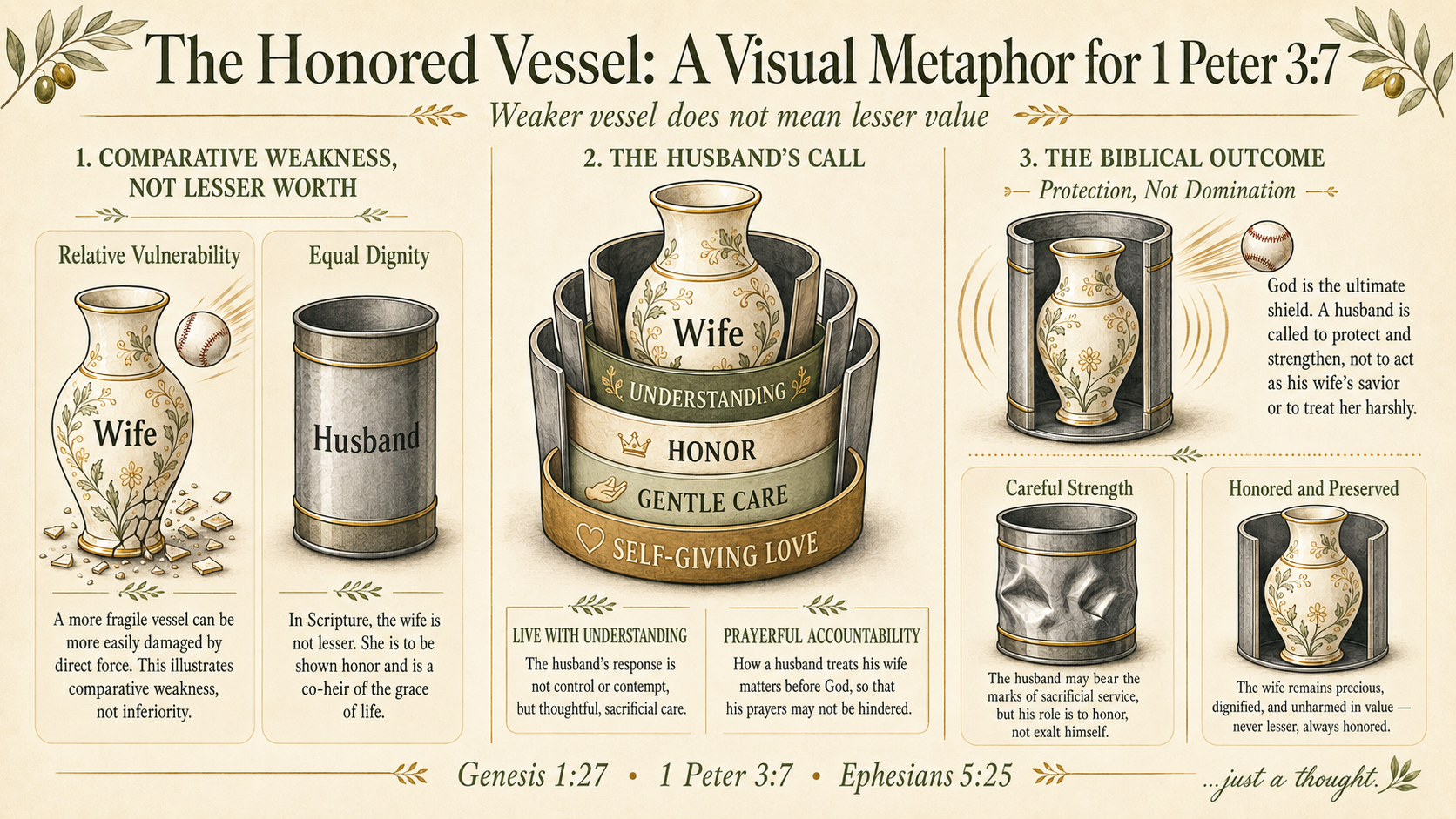
<p>1 Peter 3:7 ESV says, <em>“Likewise, husbands, live with your wives in an understanding way, showing honor to the woman as the weaker vessel, since they are heirs with you of the grace of life, so that your prayers may not be hindered.”</em> That sentence does not stand over wives to reduce them. It stands before husbands to sober them. Peter does not use <em>“weaker vessel”</em> to lower a wife’s worth; he uses it to raise a husband’s responsibility.</p>

<figure style="margin: 2rem 0; text-align: center;">
  <a href="/img/posts/the-honored-vessel-infographic.png" target="_blank" rel="noopener">
    <img src="/img/posts/the-honored-vessel-infographic.png" alt="The Honored Vessel infographic explaining that weaker vessel does not mean lesser value in 1 Peter 3:7" style="max-width: 100%; height: auto; display: block; margin: 0 auto;" />
  </a>
  <figcaption style="margin-top: 0.75rem; font-style: italic;">
    The Honored Vessel: a visual reflection on 1 Peter 3:7. <em>Click the image to view full size.</em>
  </figcaption>
</figure>

<p>That distinction matters because the phrase <em>“weaker vessel”</em> can easily be isolated from the rest of the verse. When that happens, it can begin to sound like a statement of hierarchy, value, or capability. But Peter immediately surrounds the phrase with understanding, honor, shared inheritance, grace, and spiritual accountability.</p>
<blockquote>
  <p>Whatever else we wrestle through in the passage, the verse itself refuses to let a husband treat his wife as less.</p>
</blockquote>

<p>A wife may be the <em>“weaker vessel”</em> in the ordinary sense of comparative physical vulnerability, but Peter does not connect that vulnerability to inferiority. He connects it to honor. That is a very different kind of instruction. He is not saying, <em>“She is weaker, so rule over her.”</em> He is saying, <em>“She is to be honored, understood, and treated with care because she is precious and because she stands with you as an heir of grace.”</em></p>

<p>That is where the vessel image helps me. If I place a porcelain vase beside a tin container, the porcelain is more vulnerable to direct force. If a baseball hits the vase, it may crack or shatter. If the same baseball hits the tin container, the tin may dent, but it can remain standing. That difference is real, but no one would honestly argue that the tin is more valuable because it is harder to break.</p>

<p>In many cases, the opposite is true. The more delicate vessel is often the one we treat with greater care. We do not protect it because it is worthless. We protect it because it matters. Its vulnerability does not diminish its beauty, purpose, or value. It simply changes how it should be handled.</p>

<p>That is the part I think we sometimes miss in this passage. Peter is not giving husbands permission to be proud of their strength. He is calling them to be careful with it. Strength in Scripture is never meant to become an excuse for control, intimidation, harshness, or self-importance.</p>
<blockquote>
  <p>In the hands of a sinful man, strength can become dangerous. In the hands of a Christ-shaped man, strength becomes service.</p>
</blockquote>

<p>This is why Peter’s command begins with understanding. A husband is not called to live with his wife according to assumption, frustration, stereotype, or convenience. He is called to know her. He is called to pay attention. He is called to consider her heart, her burdens, her fears, her joys, her story, her body, her limits, her strengths, and the ways she experiences life differently than he does.</p>

<p>Understanding does not mean a husband will always immediately comprehend everything his wife feels or needs. It means he refuses to be lazy with her heart. It means he does not dismiss what he has not taken time to understand. It means he approaches her as someone entrusted to him, not as someone beneath him.</p>

<p>Then Peter says to show honor. That word should slow us down. Honor is not the same as merely avoiding harm. A husband can avoid obvious cruelty and still fail to honor his wife. Honor means he treats her as weighty, valuable, dignified, and worthy of care. It means his words, decisions, tone, habits, and private attitudes should reflect that she is precious before God.</p>

<p>This is where the passage becomes deeply practical. A husband cannot claim to honor his wife while consistently belittling her, ignoring her, intimidating her, embarrassing her, or treating her concerns as annoyances. He cannot use Scripture to demand respect while refusing the part of Scripture that commands him to give honor.</p>
<blockquote>
  <p>Biblical headship, however one works through the larger conversation, can never be separated from Christlike sacrifice.</p>
</blockquote>

<p>Ephesians 5 gives us that larger picture. Husbands are called to <em>love their wives as Christ loved the church and gave Himself up for her.</em> That kind of love does not use authority to take. It uses strength to give. It does not crush what is vulnerable. It moves toward what is vulnerable with patience, protection, tenderness, and care.</p>

<p>This is also why we have to be careful with the idea of protection. Protection is not domination. A shield protects by absorbing harm, not by suffocating what it protects. A husband is not his wife’s savior, and he is not called to replace God in her life. Christ is her Lord, her Redeemer, her refuge, and her ultimate covering.</p>

<p>A husband’s role is humbler than that, but still serious. He is called to be a faithful servant within the covenant, using whatever strength, influence, presence, and leadership he has for her good. If he bears the marks of sacrifice, those marks should not become trophies for his ego. They should simply be evidence that he chose love over self-protection.</p>

<p>That may be one of the hardest parts for husbands to receive. Peter does not end the verse by saying, <em>“Do this so your marriage will look respectable.”</em> He says to do this <em>“so that your prayers may not be hindered.”</em> In other words, how a husband treats his wife matters before God. The private tone, the careless words, the harsh reactions, the indifference, the selfishness, and the unwillingness to understand are not hidden from the Lord.</p>

<p>That should sober every husband, because God does not seem impressed by public spirituality that is contradicted by private harshness. A man may pray eloquently, serve visibly, lead confidently, and speak biblically, but if he dishonors his wife, Peter says something is wrong.</p>
<blockquote>
  <p>His marriage is not separate from his walk with God. It is one of the places where his walk with God is revealed.</p>
</blockquote>

<p>At the same time, this passage should not be turned into a weapon against husbands who are sincerely trying to grow. There is a difference between a man who struggles imperfectly toward Christlike love and a man who uses strength to excuse selfishness. Most husbands will have moments where they look back and realize they could have listened better, spoken softer, cared more patiently, or paid closer attention. The point is not perfection. The point is repentance, humility, and growth.</p>

<p>That is why I keep coming back to the honored vessel. The wife is not honored because she is weak in value. She is honored because she is made in the image of God, joined with her husband as a co-heir of grace, and entrusted to him in covenant love. Her dignity does not come from her husband’s treatment of her, but his treatment of her should agree with the dignity God has already given her.</p>

<p>The metaphor is not perfect because no metaphor is. A wife is not merely porcelain, and a husband is not merely tin. Women are not helpless, and men are not automatically strong in all the ways that matter. Many wives carry incredible spiritual, emotional, intellectual, and relational strength, and many husbands have to learn that true strength is not proven by control but by humility.</p>

<p>Still, the picture helps me see the passage more clearly. The issue is not whether one vessel can withstand more force than another. The issue is whether the more durable vessel understands why durability was given. If strength does not lead to honor, it has already been misused.</p>
<blockquote>
  <p>If leadership does not look like sacrificial love, it has drifted away from Christ.</p>
</blockquote>

<p>Maybe that is the invitation in 1 Peter 3:7. Not for wives to see themselves as lesser, and not for husbands to see themselves as greater, but for both to remember what God says is true. She is to be honored. He is accountable for how he handles her. They are heirs together of the grace of life.</p>

<p>And in a world that often confuses strength with power, maybe Christian marriage is meant to show something better. Strength can be gentle. Honor can be practical. Protection can serve without controlling. Love can absorb the cost without making itself the center.</p>

<blockquote>
  <p><em>“Weaker vessel”</em> was never meant to mean lesser value. It was meant to call forth greater care.</p>
</blockquote>

<p>“…just a thought.”
<!--stackedit_data:
eyJoaXN0b3J5IjpbLTE0NzQ1NDQzMTBdfQ==
--></p>]]></content><author><name>Jeff Thomas III</name></author><category term="faith" /><category term="marriage" /><category term="biblical-marriage" /><category term="marriage" /><category term="biblical-marriage" /><category term="husband-and-wife" /><category term="love-and-respect" /><category term="covenant" /><category term="scripture" /><category term="biblical-reflection" /><category term="spiritual-growth" /><summary type="html"><![CDATA[A reflective look at 1 Peter 3:7 and why a husband's strength is meant for understanding, honor, and sacrificial care rather than control.]]></summary><media:thumbnail xmlns:media="http://search.yahoo.com/mrss/" url="https://justathoughtblog.org/img/posts/the-honored-vessel.jpg" /><media:content medium="image" url="https://justathoughtblog.org/img/posts/the-honored-vessel.jpg" xmlns:media="http://search.yahoo.com/mrss/" /></entry><entry><title type="html">The Stories We Tell Ourselves</title><link href="https://justathoughtblog.org/marriage/reflections/2026/06/24/the-stories-we-tell-ourselves.html" rel="alternate" type="text/html" title="The Stories We Tell Ourselves" /><published>2026-06-24T00:00:00-07:00</published><updated>2026-06-24T00:00:00-07:00</updated><id>https://justathoughtblog.org/marriage/reflections/2026/06/24/the-stories-we-tell-ourselves</id><content type="html" xml:base="https://justathoughtblog.org/marriage/reflections/2026/06/24/the-stories-we-tell-ourselves.html"><![CDATA[<p>The other day I stepped out of my office for lunch while my wife was working in the next room. Like many couples today, we’re both hybrid workers. Some days we’re in the office, some days we’re working from home, and on this particular day we were both home. When I walked into the room, she told me she had bought me a hamburger for lunch. Then she mentioned there was half a piece of cake if I wanted dessert.</p>

<p>Without thinking much about it, and mostly trying to be funny, I replied, <em>“So you’re giving me your leftovers?”</em> She smiled and said, <em>“It’s shared.”</em> We both laughed and moved on with our day, but for some reason that short exchange stayed with me.</p>

<p>The more I thought about it, the more I realized that neither of us was wrong. There really was half a piece of cake sitting on the counter. Part of it had already been eaten. From my perspective, calling it leftovers wasn’t inaccurate. But my wife wasn’t looking at it from that perspective. She wasn’t thinking about what had already been eaten. She was thinking about what had been intentionally saved. In her mind, the cake wasn’t an afterthought. It was something she was sharing with me. The facts were exactly the same, but our focus was different.</p>

<blockquote>
  <p>I was focused on what was gone and had already been consumed. She was focused on what remained and what was being offered.</p>
</blockquote>

<p>As I reflected on that conversation, I started noticing how often this happens in relationships. We experience something, observe something, or hear something said, and almost immediately our minds begin constructing a story around it.</p>

<p>Most of the time, we don’t even realize we’re doing it. Someone forgets something important, and we tell ourselves a story about how much they care. Someone says something awkwardly, and we tell ourselves a story about what they meant. Someone seems distracted, distant, or preoccupied, and we tell ourselves a story about why.</p>

<p>Sometimes those stories are accurate. Sometimes they aren’t. The challenge is that once we’ve settled on an explanation, we tend to treat it as fact. What began as an interpretation quietly becomes a conclusion.</p>

<p>I’ve noticed this is especially important in marriage because the people closest to us often receive the least charitable interpretations from us. Strangers get the benefit of the doubt. Coworkers get the benefit of the doubt. Friends often get the benefit of the doubt.</p>

<p>Yet somehow the people we love most can end up carrying the weight of our assumptions. A forgotten task becomes evidence of indifference. A poorly worded comment becomes evidence of criticism. A moment of distraction becomes evidence of disinterest. Over time, those interpretations can shape a relationship just as much as the actual events themselves.</p>

<p>What struck me about my wife’s response was how naturally she viewed the situation through a lens of generosity. She wasn’t arguing with my description. She simply saw something different in the same set of facts.</p>

<blockquote>
  <p>The cake had been saved. It was meant to be shared.</p>
</blockquote>

<p>That small moment reminded me that our perspective often determines what we see. We can focus on what was taken, what was lost, what was consumed, and what was missing. Or we can focus on what was given, what was preserved, what remains, and what is being offered.</p>

<blockquote>
  <p>Both perspectives may contain elements of truth, but they don’t lead us to the same place.</p>
</blockquote>

<p>I think that’s part of what Paul is getting at when he writes that love <em>“bears all things, believes all things, hopes all things, endures all things”</em> (1 Corinthians 13:7 ESV). Love is not blind, and it isn’t naive. But love does resist the urge to immediately assume the worst possible explanation. It leaves room for grace. It leaves room for good intentions. It leaves room for the possibility that there may be more to the story than our first interpretation suggests.</p>

<blockquote>
  <p>The longer I’ve been married, the more convinced I’ve become that many conflicts are not rooted in what happened as much as they are rooted in the meaning we’ve assigned to what happened.</p>
</blockquote>

<p>The stories we tell ourselves matter. Sometimes those stories bring us closer together. Sometimes they quietly build walls. And sometimes all it takes to change the story is a simple reminder that what looked like leftovers to one person looked like something shared to another.</p>

<p>…just a thought.
<!--stackedit_data:
eyJoaXN0b3J5IjpbLTEzMTgxNzUyNzddfQ==
--></p>]]></content><author><name>Jeff Thomas III</name></author><category term="marriage" /><category term="reflections" /><category term="marriage" /><category term="communication" /><category term="perspective" /><category term="relationships" /><category term="grace" /><category term="husband-and-wife" /><summary type="html"><![CDATA[A simple lunchtime conversation about a piece of cake became a reminder of how often our relationships are shaped by the stories we tell ourselves, not just the facts in front of us.]]></summary><media:thumbnail xmlns:media="http://search.yahoo.com/mrss/" url="https://justathoughtblog.org/img/posts/the-stories-we-tell-ourselves.jpg" /><media:content medium="image" url="https://justathoughtblog.org/img/posts/the-stories-we-tell-ourselves.jpg" xmlns:media="http://search.yahoo.com/mrss/" /></entry><entry><title type="html">Created, Fallen, Restored</title><link href="https://justathoughtblog.org/faith/reflections/2026/06/09/created-fallen-restored.html" rel="alternate" type="text/html" title="Created, Fallen, Restored" /><published>2026-06-09T00:00:00-07:00</published><updated>2026-06-09T00:00:00-07:00</updated><id>https://justathoughtblog.org/faith/reflections/2026/06/09/created-fallen-restored</id><content type="html" xml:base="https://justathoughtblog.org/faith/reflections/2026/06/09/created-fallen-restored.html"><![CDATA[<p>Every now and then, I encounter something that reminds me how difficult it is to explain humanity.</p>

<p>People can be remarkably compassionate. They sacrifice for their families, serve complete strangers, and give generously with little expectation of receiving anything in return. Throughout history, ordinary men and women have devoted their lives to healing the sick, defending the vulnerable, and improving the lives of people they may never meet.</p>

<p>At the same time, people can be selfish, prideful, cruel, and destructive. We live in a world marked by conflict, betrayal, violence, and injustice. Even the most admirable people have moments they wish they could take back, and even the most disciplined among us know what it feels like to fall short of our own standards.</p>

<blockquote>
  <p>What makes this reality so difficult to explain is that both observations are true.</p>
</blockquote>

<p>Humanity is capable of extraordinary good, yet it is equally capable of extraordinary evil. The contradiction is not merely something we observe in society or read about in history books. It is something we experience personally. Most of us have felt the tension of wanting to do what is right while simultaneously battling desires, attitudes, or impulses that pull us in another direction.</p>

<p>For generations, people have tried to make sense of this tension. Some argue that humanity is fundamentally good and that our failures are primarily the result of environment, upbringing, or circumstance. Others insist that people are fundamentally corrupt and that any appearance of goodness is merely self-interest in a more socially acceptable form.</p>

<blockquote>
  <p>Neither explanation seems to tell the whole story.</p>
</blockquote>

<p>If people are only good, it becomes difficult to explain the darkness that continues to surface throughout history and within our own hearts. If people are only bad, it becomes equally difficult to explain acts of courage, sacrifice, creativity, love, and compassion that emerge even in the harshest circumstances.</p>

<blockquote>
  <p>Scripture offers a different perspective, one that is both more honest and more hopeful.</p>
</blockquote>

<p>The Bible begins by telling us that humanity was created in the image of God. From the very beginning, men and women were designed to reflect something of their Creator’s character. Our desire for beauty, justice, creativity, relationship, purpose, and love is not accidental. These qualities point back to the One in whose image we were made.</p>

<p>This truth explains much of what is admirable about humanity. It explains why people long for meaning, why they recognize injustice when they see it, and why they continue searching for something greater than themselves. Even in a broken world, traces of God’s design remain visible.</p>

<blockquote>
  <p>Yet the biblical story does not end in Genesis 1.</p>
</blockquote>

<p>Genesis 3 introduces another reality that is just as necessary for understanding the human condition. Sin enters the world, and with it comes corruption, separation, and disorder. The image of God in humanity is not erased, but it is distorted. The goodness that remains is now entangled with selfishness, pride, fear, and rebellion.</p>

<p>This helps explain why human beings often feel divided within themselves. We can desire what is good while simultaneously resisting it. We can genuinely love others while still acting out of selfish motives. We can recognize truth while choosing convenience. The tension exists because we were created for one thing and have become something else.</p>

<p>In many ways, every person lives in the space between those two realities. We bear the dignity of being created in God’s image while also carrying the consequences of a fallen nature. The remarkable thing about Christianity is that it refuses to ignore either side of that equation.</p>

<p>The gospel does not flatter us by pretending we are better than we are. At the same time, it does not reduce us to our failures and shortcomings. Instead, it tells the truth about both our dignity and our brokenness. We were created by God, we have fallen into sin, and we are unable to restore ourselves. That is where the story of redemption begins.</p>

<p>Through Christ, God does more than simply forgive sin. He begins the work of restoration. The New Testament repeatedly describes the Christian life as a process of transformation in which believers are being conformed to the image of Christ. What was distorted by sin is being renewed by grace.</p>

<p>This process is rarely immediate and never effortless. It involves repentance, surrender, growth, correction, and perseverance. There are days when progress feels obvious and days when it feels painfully slow. Yet one of the promises of Scripture is that God has not abandoned His work. He is shaping His people into what they were always intended to become.</p>

<p>Perhaps this is why the Christian understanding of humanity feels so complete. It accounts for the beauty we see in people without ignoring the brokenness. It acknowledges our failures without surrendering to despair. It explains why we long for something greater while also explaining why we struggle to attain it on our own.</p>

<blockquote>
  <p>We are created in God’s image. We are fallen through sin. And through Christ, we are being restored.</p>
</blockquote>

<p>The entire story of humanity can be understood through those three realities, and perhaps many of the contradictions we wrestle with begin to make sense when we view ourselves through that lens.</p>

<p>…just a thought.
<!--stackedit_data:
eyJoaXN0b3J5IjpbLTgwNjI2NjgwNiwtMjAzMTgyNzk1Nl19
--></p>]]></content><author><name>Jeff Thomas III</name></author><category term="faith" /><category term="reflections" /><category term="christian-living" /><category term="discipleship" /><category term="biblical-reflection" /><category term="sanctification" /><category term="human-nature" /><category term="image-of-god" /><category term="redemption" /><summary type="html"><![CDATA[A reflective exploration of why humanity is capable of both remarkable good and profound brokenness, and how Scripture explains the tension through creation, the fall, and redemption.]]></summary><media:thumbnail xmlns:media="http://search.yahoo.com/mrss/" url="https://justathoughtblog.org/img/posts/created-fallen-restored.jpg" /><media:content medium="image" url="https://justathoughtblog.org/img/posts/created-fallen-restored.jpg" xmlns:media="http://search.yahoo.com/mrss/" /></entry><entry><title type="html">The Difference Hope Makes</title><link href="https://justathoughtblog.org/faith/reflections/2026/06/07/the-difference-hope-makes.html" rel="alternate" type="text/html" title="The Difference Hope Makes" /><published>2026-06-07T00:00:00-07:00</published><updated>2026-06-07T00:00:00-07:00</updated><id>https://justathoughtblog.org/faith/reflections/2026/06/07/the-difference-hope-makes</id><content type="html" xml:base="https://justathoughtblog.org/faith/reflections/2026/06/07/the-difference-hope-makes.html"><![CDATA[<p>In 1915, Sir Ernest Shackleton and his crew set out on what was supposed to be one of the greatest Antarctic expeditions in history. Instead, they found themselves trapped in ice hundreds of miles from civilization after their ship, <em>Endurance</em>, became frozen in place.</p>

<p>For months they waited as the ice tightened around the ship. Eventually, the pressure became too much. The ship was crushed and sank beneath the frozen sea, leaving the crew stranded in one of the most unforgiving environments on earth.</p>

<p>What followed was a remarkable story of survival. The men camped on drifting ice, survived brutal weather, crossed open ocean in small lifeboats, and endured conditions that would have broken most people. Yet every member of the expedition survived.</p>

<p>Historians have written extensively about Shackleton’s leadership, but one detail has always stood out to me. He seemed to understand that preserving hope was every bit as important as preserving food, shelter, or equipment. He maintained routines. He gave his men meaningful work. He projected confidence when circumstances offered very little reason for it. He consistently directed their attention toward rescue rather than despair.</p>

<p>The ice remained dangerous. The cold remained relentless. The uncertainty never completely disappeared. What changed was their ability to endure it. That story has been sitting with me lately because it raises an interesting question: <em>How much of human endurance is actually connected to hope?</em></p>

<p>The longer I live, the more convinced I become that hope may be one of the most powerful forces in human life. We often think of hope as something soft or sentimental, but in reality it may be one of the strongest motivators we possess. People will endure astonishing hardship when they believe there is something waiting on the other side of it.</p>

<p>A patient may agree to difficult treatments because there is hope that the treatment will work. A student may spend years studying because there is hope that the sacrifice will eventually open new opportunities. A husband and wife may continue working through painful conversations because there is hope that healing and understanding are still possible. Parents willingly endure sleepless nights, financial pressures, and countless sacrifices because they hope for the future of their children.</p>

<p>In each of these examples, the hardship is real. Hope does not remove the struggle, but it gives the struggle meaning. It provides a reason to continue moving forward when stopping would be easier.</p>

<p>The opposite is true as well. When people lose hope, even manageable difficulties can begin to feel unbearable. Problems that once seemed temporary start to feel permanent. Obstacles that could have been overcome suddenly appear impossible. The circumstances may not have changed much at all, but the absence of hope changes how those circumstances are experienced. That observation extends far beyond individual stories.</p>

<p>History is filled with examples of people enduring imprisonment, persecution, disease, poverty, war, and tragedy because they believed something better remained ahead. Sometimes that hope was tied to freedom. Sometimes it was tied to family. Sometimes it was tied to a cause they believed was worth suffering for.</p>

<p>Whatever form it took, hope gave them the strength to endure what might otherwise have crushed them.</p>

<p>In Scripture, when Paul writes in Romans 5 that suffering produces endurance, endurance produces character, and character produces hope, he is describing something profoundly human. Trials reveal what we are trusting in. They expose the limits of our own strength and remind us how little control we actually have over many of the things we value most.</p>

<p>None of us plans for suffering. None of us volunteers for grief. None of us wakes up hoping for a difficult diagnosis, a season of uncertainty, or a painful loss. Yet these realities eventually find all of us. The question is not whether we will face hardship but what will sustain us when we do.</p>

<blockquote>
  <p>As I thought more about hope, I realized that not all hopes carry the same weight.</p>
</blockquote>

<p>Some hopes are tied to outcomes. We hope the treatment works. We hope the relationship heals. We hope the financial pressure eases. We hope our children make wise decisions. We hope the diagnosis is wrong. We hope the phone call comes. We hope the door opens. There is nothing wrong with any of those hopes. In fact, it would be difficult to live without them. The challenge is that all of them depend upon circumstances that remain outside our control.</p>

<p>Anyone who has lived long enough knows that some prayers are answered exactly as we hoped, while others are answered very differently than we expected. Some relationships are restored. Some are not. Some illnesses are healed. Others are carried until the end of life. Some dreams become reality. Others remain unfinished.</p>

<blockquote>
  <p>If our hope rests entirely upon a specific outcome, then our hope becomes vulnerable to whatever happens next.</p>
</blockquote>

<p>That may be one reason Scripture consistently directs our attention beyond present circumstances. The Bible never tells us to pretend suffering isn’t real, nor does it encourage us to deny grief, disappointment, or loss. Instead, it anchors hope in something larger than any single chapter of our lives.</p>

<p>The Christian hope is not ultimately that life will go according to plan. It is that God remains faithful even when life does not. It is the conviction that Christ has defeated death, that His promises remain true, and that no suffering we experience today will have the final word. It is the confidence that history is moving toward a conclusion secured not by human effort but by the work of Christ Himself.</p>

<blockquote>
  <p>That perspective does not eliminate pain, but it changes how we carry it.</p>
</blockquote>

<p>A believer facing a difficult diagnosis may still pray fervently for healing while recognizing that his ultimate hope rests somewhere deeper than the outcome of a medical test. A husband and wife struggling through a painful season may still hope for reconciliation while recognizing that their confidence is not ultimately rooted in their ability to fix everything perfectly. A family standing beside a grave may grieve deeply while also believing that death is not the end of the story.</p>

<p>Christian hope is not optimism. Optimism says things will probably work out. Hope says that even if life unfolds differently than I wanted, God is still trustworthy. That distinction matters because optimism survives only as long as circumstances cooperate. Hope can endure even when circumstances collapse.</p>

<p>Perhaps that is why hope has sustained people through persecution, imprisonment, disease, tragedy, and loss throughout history. It allows them to look honestly at present reality without surrendering to despair. It acknowledges the darkness without concluding that darkness wins.</p>

<p>When I think about Shackleton’s crew stranded in the Antarctic, I am reminded that human beings can endure extraordinary hardship when they believe rescue lies ahead. Their hope was fixed on ships that would eventually come for them and loved ones waiting for them at home.</p>

<p>As Christians, we are also people waiting for rescue, although ours is far greater. We wait for the return of Christ. We wait for the redemption of creation. We wait for the day when suffering, sin, and death finally lose their grip on the world.</p>

<blockquote>
  <p>Until then, hope carries us. Not because we know exactly what tomorrow holds, but because we know who holds tomorrow.</p>
</blockquote>

<p>And when hope is anchored there, it becomes strong enough to endure almost anything.</p>

<p>…just a thought.
<!--stackedit_data:
eyJoaXN0b3J5IjpbLTk2MTY3NzgyXX0=
--></p>]]></content><author><name>Jeff Thomas III</name></author><category term="faith" /><category term="reflections" /><category term="hope" /><category term="faith" /><category term="perseverance" /><category term="suffering" /><category term="christian-living" /><category term="resurrection" /><summary type="html"><![CDATA[A reflective look at how hope enables people to endure suffering, uncertainty, and loss, and why Christian hope rests in something deeper than circumstances.]]></summary><media:thumbnail xmlns:media="http://search.yahoo.com/mrss/" url="https://justathoughtblog.org/img/posts/the-difference-hope-makes.jpg" /><media:content medium="image" url="https://justathoughtblog.org/img/posts/the-difference-hope-makes.jpg" xmlns:media="http://search.yahoo.com/mrss/" /></entry><entry><title type="html">Strong Enough to Be Gentle: The Lie of the Lone Wolf</title><link href="https://justathoughtblog.org/faith/leadership/marriage/2026/05/30/strong-enough-to-be-gentle-the-lie-of-the-lone-wolf.html" rel="alternate" type="text/html" title="Strong Enough to Be Gentle: The Lie of the Lone Wolf" /><published>2026-05-30T00:00:00-07:00</published><updated>2026-05-30T00:00:00-07:00</updated><id>https://justathoughtblog.org/faith/leadership/marriage/2026/05/30/strong-enough-to-be-gentle-the-lie-of-the-lone-wolf</id><content type="html" xml:base="https://justathoughtblog.org/faith/leadership/marriage/2026/05/30/strong-enough-to-be-gentle-the-lie-of-the-lone-wolf.html"><![CDATA[<p>I recently listened to a <a href="https://youtu.be/2fBVdWRs62Q?si=bGWWZvS_oS19Nudv">podcast interview with Jason Wilson</a> where he mentioned something I had never really considered before. He talked about wolves and pointed out that the leaders of a wolf pack are often described not as a lone alpha male, but as an alpha pair—a bonded male and female working together for the good of the pack.</p>

<p>Now, before anyone writes me a lengthy email about wolf biology, I realize analogies have limits. Nature is not our ultimate source of truth, and God’s design for marriage and leadership is not based on the behavior of animals. Still, the idea stuck with me because it pushed against a message that seems to be growing louder in our culture: the idea that the ideal man is a lone wolf.</p>

<p>The lone wolf is independent. He doesn’t need anyone. He trusts no one. He stands alone and answers to no one. In many circles, that image has become a symbol of strength.</p>

<blockquote>
  <p>The more I thought about it, though, the more I wondered if we have confused isolation with strength.</p>
</blockquote>

<p>Many men today are trying to figure out what it means to be masculine. Some have watched passivity produce weak leadership, broken families, and men who refuse to take responsibility. Others have reacted by embracing a version of masculinity that seems defined almost entirely by dominance, aggression, and emotional detachment.</p>

<blockquote>
  <p>Neither extreme looks much like the men we find in Scripture.</p>
</blockquote>

<p>When I read about biblical manhood, I don’t see weak men, but I also don’t see hard-hearted men. I see men who are called to courage, conviction, responsibility, and leadership. At the same time, they are called to humility, self-control, compassion, and love. The tension between those qualities is where I think many men struggle.</p>

<p>It is easy to mistake hardness for strength. A man can become emotionally distant and call it discipline. He can become controlling and call it leadership. He can refuse to be vulnerable and call it toughness. But none of those things necessarily indicate strength. Sometimes they simply reveal fear hidden behind a different name.</p>

<blockquote>
  <p>That is one reason I appreciate the idea of the warrior poet.</p>
</blockquote>

<p>The warrior poet is strong, but his strength is not his entire identity. He knows how to fight when necessary, but he also knows what is worth protecting. He possesses conviction without becoming harsh and courage without becoming arrogant. He understands that strength exists for a purpose beyond itself.</p>

<p>In many ways, King David embodies this tension. David was a warrior who faced giants, led armies, and defended his people. Yet he was also a poet who poured out his fears, failures, hopes, and praises before God. The same man who stood before Goliath also wrote some of the most vulnerable words in Scripture.</p>

<blockquote>
  <p>That combination is striking because our culture often tells men they must choose between strength and tenderness. David demonstrates that mature masculinity requires both.</p>
</blockquote>

<p>The same principle applies to marriage. Scripture teaches that husbands have a responsibility to lead their families, but biblical leadership has never been about domination. Ephesians 5 does not point husbands toward self-serving authority; it points them toward Christ. Husbands are called to love their wives as Christ loved the church and gave Himself up for her.</p>

<p>That kind of leadership requires strength, but not the kind of strength our culture often celebrates. It requires the strength to sacrifice. The strength to serve. The strength to listen before speaking. The strength to remain steady when circumstances become difficult. Most importantly, it requires the strength to place someone else’s good ahead of your own comfort.</p>

<p>When I think about the men I have respected most throughout my life, very few fit the stereotype of the modern alpha male. They were not the loudest men in the room, nor were they constantly trying to prove themselves. What stood out about them was their steadiness. They were dependable. Their families felt safe around them. Their convictions were clear, but so was their compassion.</p>

<p>Perhaps that is because genuine strength is not measured by how many people you can control. It is measured by how well you can control yourself.</p>

<blockquote>
  <p>Ultimately, every discussion about masculinity eventually leads me back to Jesus.</p>
</blockquote>

<p>Christ was not passive. He confronted corruption, spoke truth boldly, endured suffering willingly, and remained faithful all the way to the cross. Yet He was also compassionate toward the broken, patient with the struggling, and gentle with those who came to Him in humility.</p>

<p>Jesus never chose between strength and gentleness because the two were never in conflict. His gentleness flowed from His strength, and His strength was always guided by perfect love.</p>

<p>Maybe that is what so many men are searching for today.</p>

<p>Not a return to passivity.</p>

<p>Not a retreat into hardness.</p>

<p>But a masculinity that reflects Christ. A masculinity that is courageous enough to lead, humble enough to serve, and strong enough to be gentle.</p>

<p>…just a thought.</p>

<p>I’ll leave you with this question to consider, <em>When the people closest to you experience your strength, do they also experience your gentleness?</em>
<!--stackedit_data:
eyJoaXN0b3J5IjpbLTMwMDU4NTEwMSwxNjA2NDAxMTY4XX0=
--></p>]]></content><author><name>Jeff Thomas III</name></author><category term="faith" /><category term="leadership" /><category term="marriage" /><category term="masculinity" /><category term="leadership" /><category term="marriage" /><category term="christian-men" /><category term="warrior-poet" /><category term="biblical-manhood" /><summary type="html"><![CDATA[Reflecting on strength, gentleness, leadership, and the temptation of the lone wolf mentality through the lens of Scripture and biblical masculinity.]]></summary><media:thumbnail xmlns:media="http://search.yahoo.com/mrss/" url="https://justathoughtblog.org/img/posts/strong-enough-to-be-gentle-lone-wolf.jpg" /><media:content medium="image" url="https://justathoughtblog.org/img/posts/strong-enough-to-be-gentle-lone-wolf.jpg" xmlns:media="http://search.yahoo.com/mrss/" /></entry><entry><title type="html">Fully Known, Fully Loved</title><link href="https://justathoughtblog.org/faith/2026/05/03/known-and-loved-fully-known-fully-loved.html" rel="alternate" type="text/html" title="Fully Known, Fully Loved" /><published>2026-05-03T00:00:00-07:00</published><updated>2026-05-03T00:00:00-07:00</updated><id>https://justathoughtblog.org/faith/2026/05/03/known-and-loved-fully-known-fully-loved</id><content type="html" xml:base="https://justathoughtblog.org/faith/2026/05/03/known-and-loved-fully-known-fully-loved.html"><![CDATA[<p>There’s something we all seem to be looking for. Even if we don’t always say it out loud.</p>
<blockquote>
  <p>To be fully known and still fully loved.</p>
</blockquote>

<p>Not partially known. Not selectively understood. But completely seen. Nothing hidden. Nothing managed. Nothing filtered, and still… accepted. That’s the kind of love people spend a lifetime trying to find, In relationships, In friendships, In marriage. And while we can experience pieces of that with others there’s always a limit.</p>
<blockquote>
  <p>Because people, no matter how well-intentioned, can only know what’s been revealed.</p>
</blockquote>

<p>And even then, understanding isn’t always perfect. But there is one place where this kind of love already exists. One where nothing is hidden, misunderstood or unknown. And yet, nothing changes the posture of love. God doesn’t love a version of us. He doesn’t love what we present. He doesn’t respond to a filtered version of who we are.</p>
<blockquote>
  <p>He sees all of it, fully, clearly, completely.</p>
</blockquote>

<p>And still chooses love. Not because everything is right. But because His love isn’t dependent on discovery. And It’s not fragile. It doesn’t adjust based on new information. It doesn’t pull back when something unexpected is revealed. It remains. And maybe that changes how we think about everything else. Because if the kind of love we’re looking for already exists then the question isn’t whether it can be found.</p>

<p>It’s whether we’re willing to receive it. To stop managing. To stop filtering. To stop holding parts back. And to stand fully known without fear. Because the foundation of that kind of love isn’t built on what we reveal.</p>
<blockquote>
  <p>It’s built on who <strong>He</strong> is.</p>
</blockquote>

<p>…just a thought.
<!--stackedit_data:
eyJoaXN0b3J5IjpbOTIxOTYzNjU0LC02NjgzNTk0MTQsLTE0Nz
E1NTgzMDBdfQ==
--></p>]]></content><author><name>Jeff Thomas III</name></author><category term="faith" /><category term="God" /><category term="identity" /><category term="love" /><summary type="html"><![CDATA[A reflection on how God models the only perfect union of being fully known and fully loved.]]></summary><media:thumbnail xmlns:media="http://search.yahoo.com/mrss/" url="https://justathoughtblog.org/img/posts/fully-known-fully-loved.jpg" /><media:content medium="image" url="https://justathoughtblog.org/img/posts/fully-known-fully-loved.jpg" xmlns:media="http://search.yahoo.com/mrss/" /></entry><entry><title type="html">Love in Marriage</title><link href="https://justathoughtblog.org/marriage/faith/2026/04/26/known-and-loved-love-in-marriage.html" rel="alternate" type="text/html" title="Love in Marriage" /><published>2026-04-26T00:00:00-07:00</published><updated>2026-04-26T00:00:00-07:00</updated><id>https://justathoughtblog.org/marriage/faith/2026/04/26/known-and-loved-love-in-marriage</id><content type="html" xml:base="https://justathoughtblog.org/marriage/faith/2026/04/26/known-and-loved-love-in-marriage.html"><![CDATA[<p>Marriage creates closeness. Shared space. Shared responsibilities. Shared routines. Over time, it can feel like two lives have fully merged into one. And in many ways, they have. But there’s a difference between sharing a life and sharing yourself. Because it’s possible to be physically close, emotionally steady, and practically aligned while still holding parts of yourself at a distance.</p>

<p>Not out of rebellion. Not out of disconnect. Just out of habit. Or caution. Or maybe even peacekeeping. You learn what works. What keeps things smooth. What avoids unnecessary tension.</p>
<blockquote>
  <p>And slowly, without realizing it, certain conversations don’t happen anymore.</p>
</blockquote>

<p>Certain thoughts stay unspoken. Certain feelings are processed privately instead of shared openly. And nothing feels broken. But something feels quieter. Less known. Less connected. It’s not always obvious. There’s no major conflict. No clear divide. Just a subtle distance that shows up in small ways. In conversations that stay surface-level. In moments where honesty is softened or redirected. In the quiet realization that some parts of you haven’t been fully shared in a long time.</p>

<p>And over time, that distance can become normal. Expected, even. Because everything else still works. The structure is there. The commitment is there. The life you’ve built together is still intact. But the question underneath it all remains.</p>
<blockquote>
  <p>Are we actually known by each other?</p>
</blockquote>

<p>Or just understood in the roles we’ve learned to play? Because marriage isn’t just about proximity. It’s about intimacy. And intimacy requires more than time spent together. It requires presence. Honesty. A willingness to let the other person see you not just live alongside you. And that kind of openness doesn’t happen automatically.</p>
<blockquote>
  <p>It has to be chosen. Again and again.</p>
</blockquote>

<p>Not just in the big moments. But in the small, everyday ones where it would be easier to stay quiet. Because over time, those small moments are what determine whether a marriage becomes a place of true connection…</p>

<p>or just shared existence.</p>

<p>…just a thought.
<!--stackedit_data:
eyJoaXN0b3J5IjpbODU5Mjc5Njg0XX0=
--></p>]]></content><author><name>Jeff Thomas III</name></author><category term="marriage" /><category term="faith" /><category term="marriage" /><category term="intimacy" /><category term="relationships" /><summary type="html"><![CDATA[A reflection on how couples can share life together while still remaining partially unknown.]]></summary><media:thumbnail xmlns:media="http://search.yahoo.com/mrss/" url="https://justathoughtblog.org/img/posts/love-in-marriage.jpg" /><media:content medium="image" url="https://justathoughtblog.org/img/posts/love-in-marriage.jpg" xmlns:media="http://search.yahoo.com/mrss/" /></entry></feed>